









By Kate Power
Features Editor
[dropcap]T[/dropcap]here are teenagers every day that wake up with one thing on their minds: How can I get more drugs today? When can I start drinking? This is a reality facing many teenagers in today’s substance-dependent society. There are ways out of this life, and there are many options right here on the Outer Banks for teenagers seeking help.
“I believe that substance abuse is a way to temporarily numb emotional pain that a teenager may be feeling,” said Andrea Johnston, Licensed Clinical Addictions Specialist Associate. “What seems to be something done for recreation or to ‘fit in with others’ can lead to addiction and dependence on the drugs or alcohol.”
What many teenagers fail to understand is that substance abuse as an adolescent, more often than not, will lead to abusive tendencies later in life, according to AACAP.org. More than 35 percent of adults with an alcohol problem developed symptoms, such as binge drinking, by age 19. Adolescent brains can easily become damaged by alcohol and substance abuse leading to problems later in life.
“Research shows that many adolescents start to drink at very young ages,” said Cheri Peele, Licensed Clinical Addictions Specialist and private counselor on the Outer Banks. “People who reported starting drinking before age 15 were four times more likely to meet the criteria for dependence at some point in their lives. Serious drinking problems, including alcoholism, typically associated with middle age, actually begin to appear during young adulthood. The younger adolescents are when they begin to drink, the more likely they are to engage in harmful or risky behaviors such as using drugs, failing in school or promiscuity.”
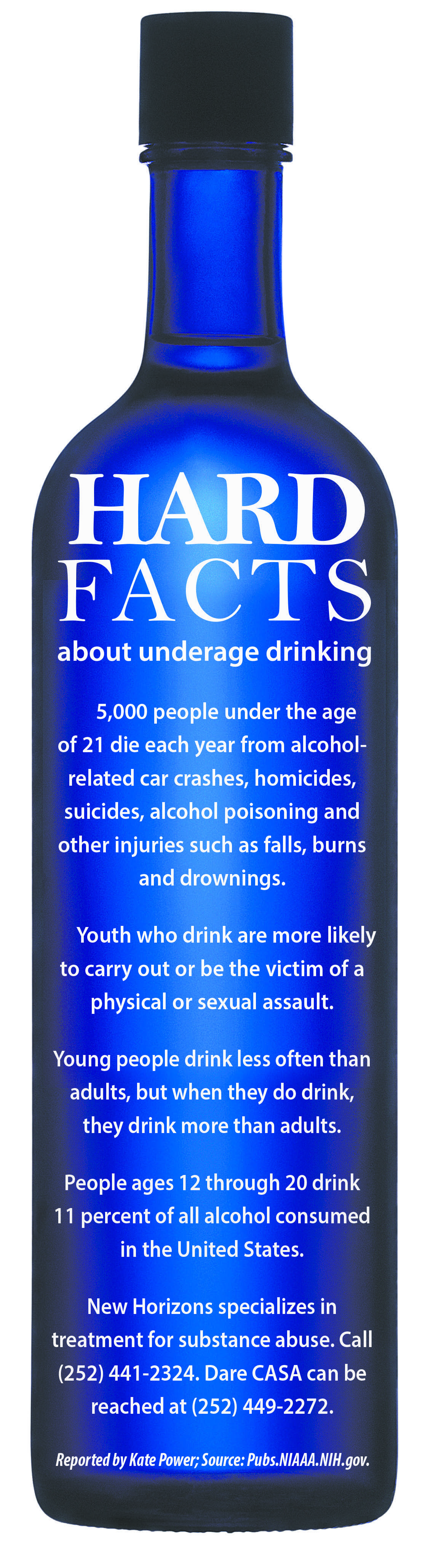
Alcohol is a drug and can do severe damage to the body of an adolescent, Peele said.
“Adolescents’ brains are not fully developed,” Peele said. “Alcohol and substance abuse may have significant long-term impacts on thinking and memory skills, elevated liver enzymes, growth and endocrine effects, etc. Alcohol and substance abuse may also upset the critical hormone balance necessary for normal development of organs, muscles and bones.”
Alcohol is labeled as a depressant. It temporarily increases the level of serotonin in the brain. Many teenagers are suffering from depression, a leading cause of substance abuse, according to NCADI.SAMHSA.gov.
Peele said alcohol elevates the levels of serotonin in the brain, temporarily causing the teen to feel happier, but he or she often does not understand that this is only temporary. Once the levels of serotonin stop increasing, the teen will feel even worse than before he or she started drinking. Substance abuse is actually a form of self-medication.
“Substance abuse can be an escape from the feelings of depression, although this escape is only temporary,” Peele said.
Genetics is another factor in teen substance abuse. Peele said children of alcoholics are four to 10 times more likely to become alcoholics themselves. The Dare Coalition Against Substance Abuse advises parents to form good relationships with their children, offer rewards for family involvement and make it known that they have high expectations for them.
“Dare CASA provides prevention services across the community,” said Amber Bodner, Drug Free Communities Support Program Director. “We don’t provide treatment services but are always eager to assist a young person with getting in touch with the proper treatment facility or clinician in our area that does provide treatment services for those struggling with addiction. Getting help is so important.”
Johnston, who has worked in two inpatient addiction treatment centers on the Outer Banks, said she has noticed a prevalence of substance abuse among teenagers here. Many struggling teens may not be aware that options for treatment are available.
Kelly Nettnin, lead health educator at the Dare County Department of Health, was brought to the Outer Banks primarily to deal with substance abuse.
“Community health assessments came back reporting that substance abuse was a major problem in Dare County,” Nettnin said. “So Anne Thomas took initiative, along with other substance abuse workers, to get funds from the government to do a demonstrative project on substance abuse.”
New Horizons saw 61 adolescents, 15 percent of their total clients, between July 1, 2011 and June 30, 2012. They offer individual and group therapy to teenagers.
Private counselors specializing in addiction are also available on the Outer Banks, and counseling services are offered directly through the school as well.
“There are many options. First, it is important that if a teenager is struggling with drugs or alcohol that they tell someone they trust like a parent, teacher, mental health professional, doctor or guidance counselor,” Johnston said. “Second, they need to get treatment and help for their addiction. There are agencies on the Outer Banks that specialize in treatment for substance abuse, such as New Horizons. A local therapist, doctor or the school guidance counselor can help make the referral to those places that specialize in addiction.”
Send comments to powerka1207@daretolearn.org