








By Emmy Benton, Editor-in-Chief
A family friend. A grocery store worker. A prominent community member. Anyone can be affected by sexual assault, either knowing someone who has experienced it or having gone through it themselves – no matter their background or influence.
The Rape, Abuse and Incest National Network, or RAINN, operates the National Sexual Assault Hotline and defines sexual assault as “sexual contact or behavior that occurs without explicit consent of the victim.”
This can be anything from unwanted touching on one end of the spectrum to rape on the other, but the constant is that the victim never agrees to such advances.
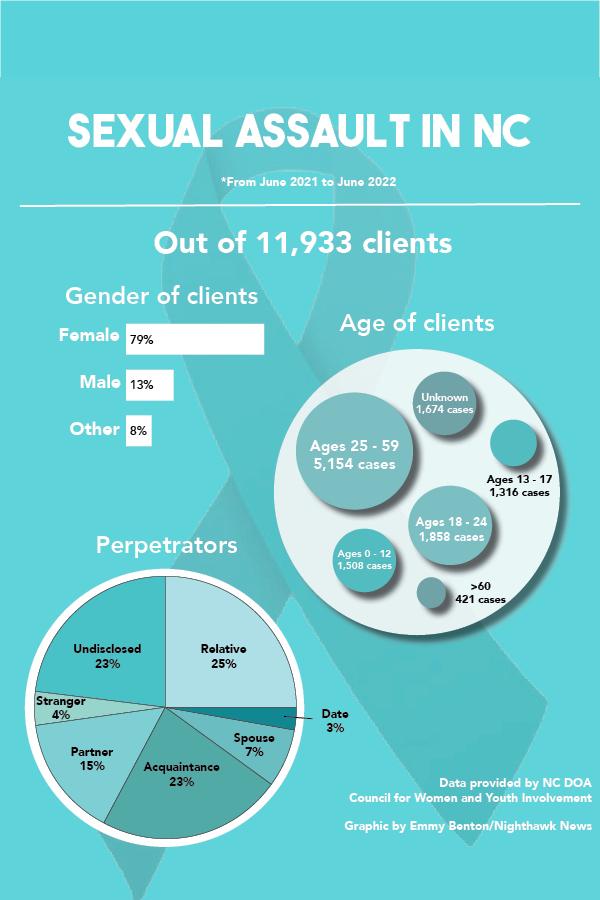
Any gender can be affected by sexual assault, but an overwhelming number of the victims are females. According to RAINN, 82% of all juvenile victims of rape are female and 90% of adult rape victims are female.
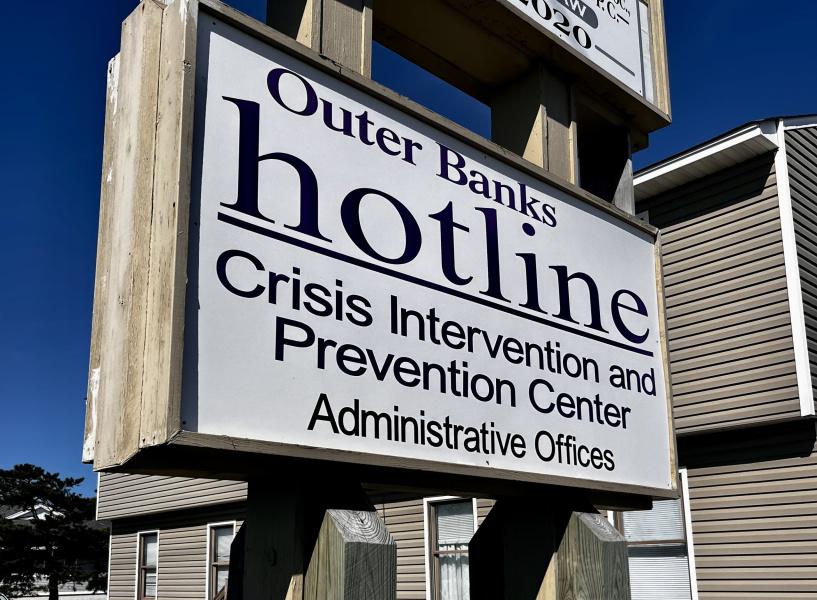
Employees at Outer Banks Hotline, a local crisis intervention and prevention center, know all too well the impacts of sexual assault in this community. For many, this comes from personal experience.
Tammie Perry, the Safe House Manager for Hotline, was sexually assaulted by a stranger more than two decades ago, something she continues to work through even today.
“As a survivor, I still, 20 years after the incident, have debilitating PTSD bouts,” Perry said. “I did not have a Hotline to call. I had no support.”
According to RAINN, 94% of women who have been sexually assaulted experience symptoms of Post-traumatic stress disorder during the first two weeks after the incident. Thirty percent of women report PTSD symptoms nine months after.
For others, the impact of the trauma presents itself in the form of substance use and abuse.
RAINN’s website says victims of sexual assault are 3.4 times more likely to use marijuana, six times more likely to use cocaine and 10 times more likely to use other major drugs.
For the Outer Banks, these numbers may be even higher because of the ever-present drug crisis affecting our area. Jackie Kiene, an investigator with the Dare County Sheriff’s Office, has seen that drugs play a role in the aftermath of sexual assault cases.
“I think drugs become a Band-Aid after,” Kiene said. “People are being sexually assaulted and then to ease the pain or the trauma, they turn to drugs.”
The impacts of sexual assault run deep and are far-reaching, something Hot-line works every day to soothe.
Stephanie Baker, the Associate Director of Outer Banks Hotline, says no one is immune to sexual violence – a harsh reality that more awareness needs to be brought to.
“It’s not one set group of people,” Baker said. “This happens to anybody, regardless of race, status, gender, it doesn’t make any difference.”
According to Hotline’s website, someone is sexually assaulted every 68 seconds in the United States. Even scarier, one in four girls and one in six boys will be sexually assaulted before the time they turn 18.
Baker believes that the topic of sexual assault should always be talked about, but particularly around prom season and summer. She wants teens to be especially cognizant of the relations they have because of the impact it can have on them in their formative years.
“You need to be aware that it’s your body and your decision, nobody else’s body and nobody else’s decision,” Baker said. “Your body is your temple and you need to honor it by making good decisions and creating boundaries. We need to do more to educate everyone that ‘no means no.’ ”
Hotline’s website says that approximately seven in 10 sexual assault instances are committed by someone the victim knows, which is all the more prevalent with teens.
“It can be people you trust, people who you hang out with, people who will be your friend,” Baker said. “More times than not, it is someone you know.”
Baker said that having clear boundaries can play a major role in preventing sexual assault from happening, and having conversations about the topic is helping to ease the stigma that is attached to survivors of sexual assault.
“A lot of people who work here (at Hotline) have mission connections and a lot of people aren’t afraid to speak out about it,” Baker said. “It’s just having that conversation, because if you don’t, it’s like, ‘Oh, it’s way over there,’ but it’s not – it’s in the room, it’s right next door, it’s sitting next to you.”
Along with sexual assault and domestic violence, Hotline also deals with human trafficking cases. Human trafficking can take many forms, such as labor trafficking, domestic servitude and sex trafficking. North Carolina is currently ninth in the country for human trafficking and is consistently in the top 10 states where human trafficking occurs.
Hotline partners with the Dare County Sheriff’s Office to tackle the issue of human trafficking and sex trafficking in Dare County. The group was recently one of only 15 task forces in the country to be awarded the Joint Human Trafficking Task Force Grant from the Office of Victims of Crime.
Kiene said the money will go straight into the community to help combat human trafficking, hopefully bringing awareness to an all-too-often neglected topic.
“We’ll use the grant to bring community awareness, training to law enforcement, community partners, and hopefully get into the schools for training,” Kiene said. “I think we focus a lot on drugs and drinking and driving, especially around prom, but we don’t really talk about the vulnerabilities of sexual assault and the resources that are there, and the lack of resources that we have.”
Perry echoed similar sentiments, but also believes that the OBX tourism industry plays a part in why sexual assault isn’t discussed more openly.
“There’s always been a stigma with sexual assault,” Perry said. “I don’t think Dare County pays enough attention to it. They’re primarily focused on tourism, and maybe they think that if things like that get out, tourists wouldn’t come. But things happen everywhere. Dare County is not an exception.”
According to RAINN, out of 1,000 sexual assault cases, 975 perpetrators walk free. Many victims don’t come forward because of the trauma it caused, the fact that the perpetrator was someone the victim knew, or simply out of fear of not being believed, just to name a few.
Because of this, Kiene said it’s extremely important for victims to come forward on their own terms and use their voice to fight for themselves.
“Be your own advocate,” Kiene said. “Don’t be afraid to stand up for yourself. You know your truth and you know what happened to you.”
Senior Emmy Benton can be reached at 23bentonem58@daretolearn.org.