












By Meghan Savona, Opinions Editor
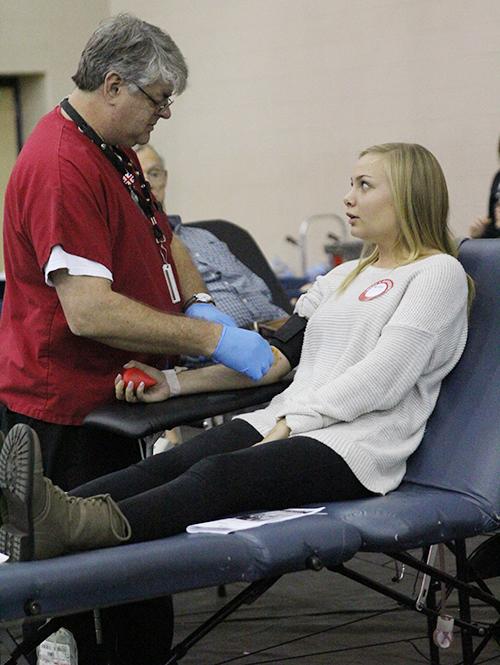
Eyes on his arm and iPhone in hand, senior Braxton Hughes anxiously awaits his turn to give blood so he can film the needle sliding into his arm. It’s not Hughes’ first time giving blood, and each time he’s given blood the process has gone as expected.
He just prefers to watch it all as it happens.
“I’m not a big needle person — I was scared, I’m not gonna lie. He said it was gonna be a small needle and it wasn’t — that thing was massive. I went into this whole ‘I’m not backing out thing,’ ” Hughes said. “They missed my vein and kept moving the needle around. I have O-negative blood and am totally willing to do it again. I saved three lives.”
Giving blood is routine for Hughes. The cotton ball sliding across his forearm, coating it with iodine just before the quick pinch of a needle piercing his skin, is nothing new. About 15 minutes and a pint of blood later, the process is complete and he’s saved three lives. The American Red Cross makes it easy to donate by hosting drives at many schools and workplaces.
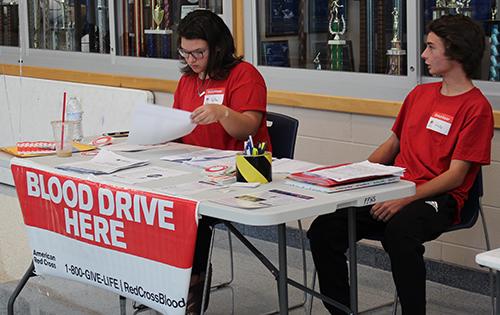
For others, however, giving blood — whether it’s the first time or the 100th time — is a nerve-racking experience. To give blood in North Carolina, the donor must be 16 years old and have parental consent, or 17 and older, so for many students the blood drive hosted at First Flight on Oct. 18 was the first time they could donate. The event was run by the FFHS HOSA Club led by Jennifer Kovacs.
“I felt good about doing a good deed. I was nervous about giving blood, but it ended up not being bad at all,” senior Nik Tsonev said.
Many sign up with the intent of giving blood, but soon find out that they’re unable to do so. To meet safety standards, Red Cross employees ask general health questions and conduct what they call a “mini physical,” testing temperature, pulse, blood pressure and hemoglobin. Senior Karsen Beckner was ready to give blood, but soon found out that she wasn’t fit to.
“I waited an hour and a half until he tested my iron level. I was at 12.4 when it needed to be 12.5, so I couldn’t give blood,” she said. “I was disappointed that I couldn’t give blood, but they told me to come back in March, and I’ll definitely be back.”
Giving blood isn’t always so simple. With closed eyes and a clenched hand squeezing a stress ball, senior Lauren Kerlin patiently sat as a collection specialist dug around in her arm to find a vein for the needle.
“They had to put three of the little compression bands around my bicep and they had to keep moving the needle around a lot. They didn’t really tell me what was wrong. All they said was that I didn’t fill the whole bag up so they can’t do anything with my blood,” she said. “My vein collapsed and the bag just stopped filling.”
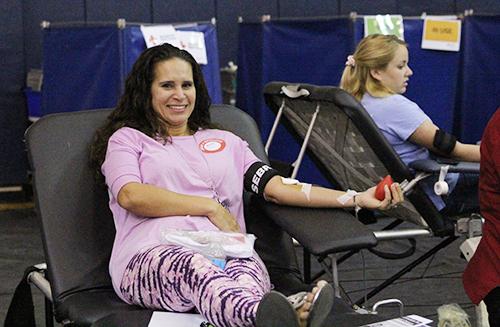
Still, plenty of students, staff members and community members spent time donating in the gym. If you’re interested in giving blood, the next blood drive will be held at First Flight on March 7. To be prepared to donate, it’s important to remember a few things:
- Eat an iron-rich diet beforehand, eating foods like spinach, beans or fish
- Drink a lot of water beforehand
- Bring your donor card or ID
- Do not exercise or participate in any strenuous activities the rest of the day
- Visit http://www.redcrossblood.org/donating-blood/tips-successful-donation.html for more information
By following these tips for a successful donation, most people walk out of the blood drive with a cookie in hand, no mishaps and a pint of blood less – until they find their next blood drive in eight weeks.
Senior Meghan Savona can be contacted at savoname0701@daretolearn.org.