








By Olivia Sugg, Staff Writer
Who is hiring? Should I reapply for my job from last year? Where are my friends working? Would they even hire me?
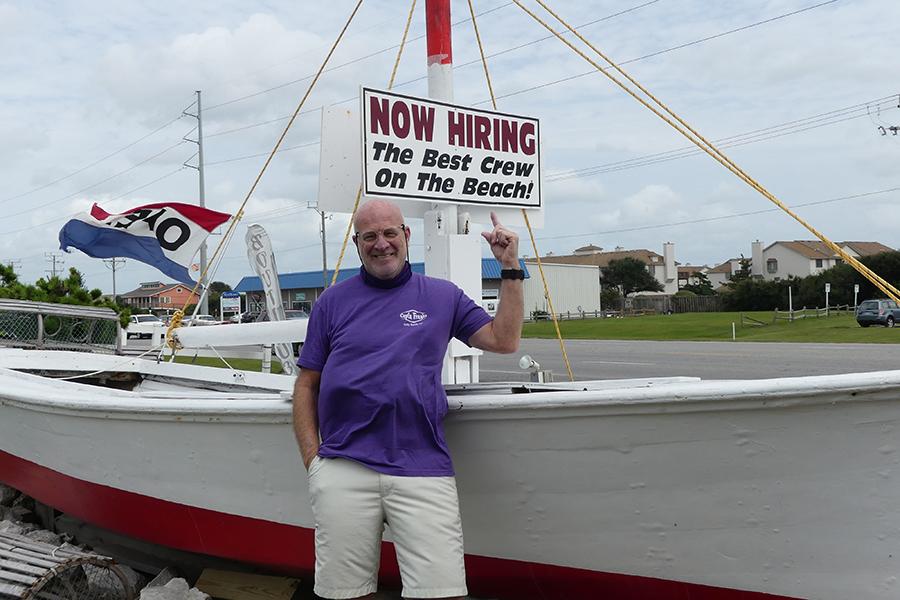
Many students ask themselves these questions every summer before getting a summer job. This year, however, “help wanted” signs seemed to appear on almost every door and local businesses were eager to hire anyone willing to work.
Despite fears of COVID-19, tourists still flooded the Outer Banks. Masks were everywhere and rental houses were at full capacity, but a shortage of employees was one of the main issues many local businesses faced.
Karen Brown, President and CEO of the Outer Banks Chamber of Commerce, described the situation as a “huge crisis.” Brown said the main reason for the employee shortage is that every year students from other countries receive J-1 visas to work in our area, but this summer travel restrictions kept J-1 students off the Outer Banks.
“Their embassies closed down, the travel restrictions went into place and then the federal government decided to stop all visa entries to the country,” Brown explained. “That’s typically about 1,700 workers that come here for the summer, but probably equates to about 3,000 jobs because they all work more than one job.”
Danielle Nigro, owner of the Dunkin Donuts stores on the beach, said her business was directly affected by the shortage of J-1 students.

“We would have normally had about 100 J-1 students to get us through the season on the Outer Banks, and because the program was closed, obviously we didn’t have any of those students,” Nigro said.
That forced Dunkin and many other local businesses to modify the way they operated this season.
“We had to go drive through only, and all of our stores had to run on reduced hours,” Nigro explained. “We even reduced our normal minimum age requirement to 14 from 16 years old.”
A lack of J-1 students was not the only cause for the employee shortage. Another factor Brown thinks contributed to the employee crisis was housing.
“We struggled to house people who might want to come here from some of the colleges,” Brown said. “You can’t pay $2,000 a month for a rental and have a summer job.”
The risk of getting infected with COVID-19 is one more element that Brown believes created an employee shortage.
“I think it’s had a big impact on whether or not parents want their 16-year-old high school students to go work at a restaurant,” Brown said.
And a final contributing factor included the government unemployment checks that went out in the COVID stimulus package.
“When COVID started in March, we had a lot of layoffs and people were on unemployment, and then they were getting that supplementary check from the federal government, which made it better for them to not work than to work,” Brown explained.
The employee shortage on the beach has not just affected employers and business owners, but it has also affected many employees who had to work overtime to combat the shortage.
Junior Pia Jastrzemski, assistant manager at Big Buck’s Ice Cream, mentioned that J-1 students have worked at Big Buck’s in previous years, and without them, they were very short-staffed.
“Everyone had to work double shifts because we didn’t have enough people,” Jastrzemski said. “I was probably working like 40 to 42 hours a week.”
She is just one of many students who were working constantly this summer due to a lack of employees. And now, this summer’s extended shoulder season is going to bring even greater challenges to many local businesses that need employees.
“I don’t think it is going to get any easier,” Brown said. “We’re hearing that we’re going to be more crowded into the fall and winter, so it’s going to be interesting.”
Are you a local business owner interested in hiring high school students? Comment below to reach the students who follow us!
Sophomore Olivia Sugg can be reached at 23suggol52@daretolearn.org.