














By Foster Guns, Staff Writer
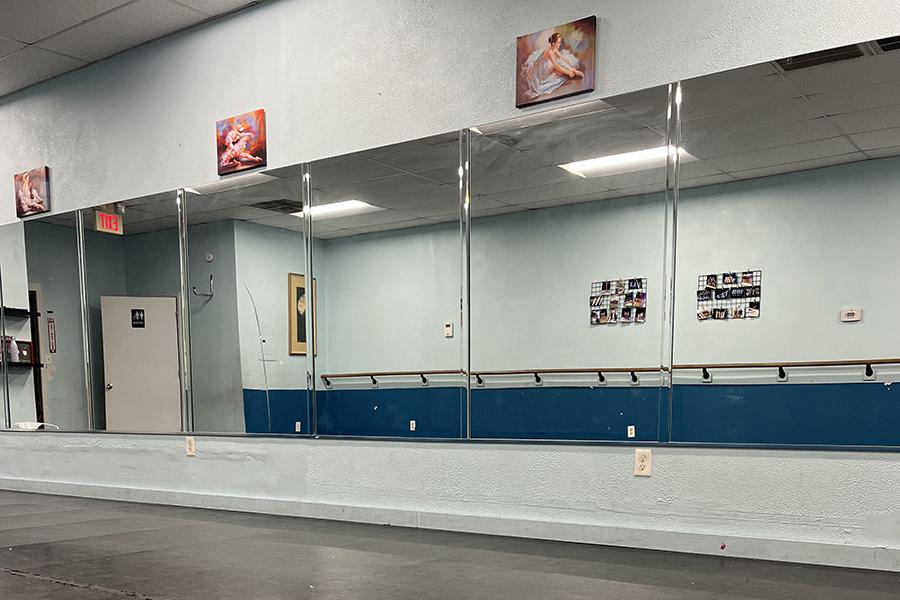
You get to dance class 10 minutes early to stretch and warm up. Intricately lacing up your pointe shoes, slicking down your bun one more time then flattening your skirt, dreading what is coming next. Being called into the studio to start barre, you all line up as you tower over the prima ballerinas in your class. All it takes is one turn to the side and a quick look in the mirror to be reminded that your leotard is the only one that doesn’t sit flat on your stomach.
The reaffirmation that you are different is one that many athletes have heard, whether it be from teammates, coaches or audiences. Senior Charlie Ernst is a plus-sized dancer who has found a home in their new studio, but the memories of their old studio are still fresh in their mind.
“I had just started dancing for the first time ever. This new girl came in every single day and would make comments on how I looked,” Ernst said. “She would say, ‘You’ll never be a real dancer. You’ll never be able to do this. You don’t look like us. You’re not one of us.’ ”
Dancers are some of the most common athletes to experience body image struggles. Between competitions and recitals, it’s easy to compare yourself to others.
A dysmorphic view of your body – being concerned that you have flaws, real or imagined, in your appearance – isn’t just a byproduct of hurtful words, but is an integral part of some sports. Senior Reagan Riddick is the only girl on the First Flight wrestling team, affecting her in ways different from her other teammates.
“In wrestling, you have to cut a lot of weight, whether it be water weight or food weight, so you can wrestle in a lower class to be the biggest and strongest,” Riddick said. “For me, cutting weight makes me look at my body differently because you can see the weight come off, making me not really want to even look at myself sometimes.”
Not only do wrestlers have to watch their weight to stay in specific classes, but they also must worry about gaining muscle mass – and weight – so they can be as strong as possible to have an advantage on the mat.
Weight fluctuations that happen day to day and week to week can be enough to shake anyone, especially those who face negative perceptions from others based on how they look in a singlet or a uniform, or even the way they move in that uniform.
A varsity cheerleader, speaking anonymously to offer candid opinions about her experience, shared feelings of being in a sort of fishbowl of imperfection.
“I’d like to think there is no weight limit on beauty, but my thighs and stomach say otherwise,” she said. “Cheer is an amazing sport, but at what point will my looks stop defining me?”
The common denominator between all these situations is the viewer – those who are passing judgment, whether it’s a huge crowd at a sporting event or someone with a mean-girl mindset in a small dance class. However, for sophomore Sadie Wilkinson, the shaming and hurtfulness came from behind the closed doors of a gymnastics gym.
Wilkinson started gymnastics and immediately fell in love with it. The bars, the beam and everything in between were her forte, until her coaches began to show their true colors.
“They would come up to you if you were in a split and put their entire adult body weight on you, punch you in the stomach or slap you in the butt to tighten your muscles,” Wilkinson said. “They were just physically aggressive, then they began to add body image into the mix – it just didn’t work out very well.”
As a kid, you’re naturally carefree with wide eyes to the world, but as an 8-year-old, Wilkinson being told to “suck in” before presenting herself to a panel of judges dimmed the glimmer of childhood in her eye, setting her up for a career-long challenge.
Dysmorphic mindsets may start in some sports from a young age, but they do not just fade off with time. A study conducted by the Sports Journal stated that 49.2% of Division I and 40.4% of Division III female athletes were in sub-clinical eating disorder range, a common byproduct of body dysmorphic disorder.
Body image struggles can affect anyone, regardless of age. Young athletes and professionals alike should be aware of the issue.
“What happened to me was not OK, but it’s something that parents and coaches need to see the change in,” Wilkinson said. “But I think it’s a big part of being an athlete to take these experiences and use them to make you better.”
Junior Foster Guns can be reached at 24gunsfo54@daretolearn.org.
