






By Maddy Wagner, Staff Writer
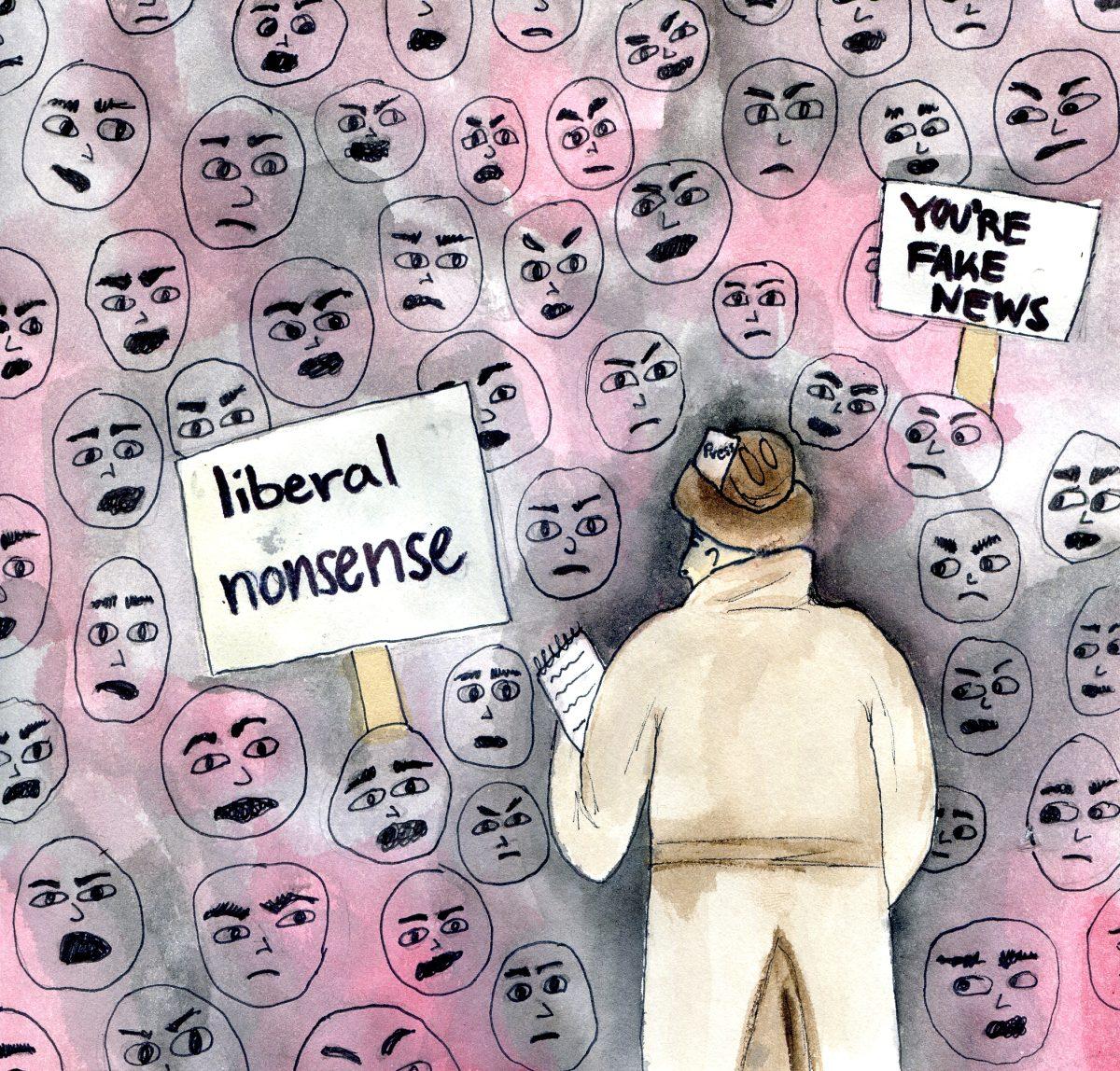
Fake News. Enemy of the people. Evil. Crazed lunatics that have given up on the truth. These are just a few of the many examples of anti-press rhetoric attributed to President Donald Trump.
The backlash and hate of this dangerous talk has seriously compromised the safety of mainstream media here at home and around the globe, as New York Times publisher A.G. Sulzberg recently expressed during a February interview on The Daily.
According to the U.S. Press Freedom Tracker, this year alone in the United States, two journalists have been arrested for doing their job, three have been attacked, five have been stopped at the U.S. border to Mexico and one has been subpoenaed.
This is all while they were simply earning a living, just like teachers who stand in front of a class of students to teach, or firefighters responding to an alarm.
While the threat Trump’s rhetoric poses to professional journalists around the world far overshadows its impact on high school journalists, it can’t be ignored that it affects all of us – even those of us eagerly just starting our careers on high school newspapers.
This hits close to home for me and is a common conversation around our dinner table lately.
A few months ago, I reported on how the government shutdown was impacting the Outer Banks. It was the first straight-up news story I had been assigned and I was excited about it. It was factual and unbiased, so I was surprised when I read a comment that called my article “liberal nonsense.” A family member of mine also works in the media business and has gotten a few negative comments such as “fake news.”
The comment on my story initially made me angry, but it also stirred something else.
Motivation.
It motivated me to keep reporting the facts and sharing the truth, regardless of what people may say. The truth needs to be reported, because it is such a fundamental part of our democracy, whether it’s covering how the government shutdown affects local students or reporting on the presidential election.
Words like “enemy” and “evil” are so dangerous, especially when used by an unhinged person who possesses the highest seat in our country. When I think of these words, the first things that come to my mind are major film antagonists like Darth Vader and Lord Voldemort.
What those words do not describe are the hundreds of thousands of journalists who are the Fourth Estate of this country, and the many journalists overseas who risk their lives to deliver the day’s news and share the truth in the face of danger.
Arabella Saunders, a former reporter for Nighthawk News, now works for the Daily Tar Heel at the University of North Carolina Chapel Hill. Journalists, she said, are those “who are trying to hold people in positions of power accountable and trying to tell other people’s stories. No one is trying to spread fake news and no one is the ‘enemy of the people.’ I think that is really dangerous, that line, ‘enemy of the people.’ ”
To illustrate the consequences of such rhetoric, she mentioned the December 2018 incident in which CNN and other organizations were the target of bomb threats.
She also recalled a recent encounter during Christmas break in which a person asked her, after learning she was majoring in journalism, “Oh, you are not going to be a fake news journalist, are you?”
Sauders said, “The fact that she felt comfortable to come at me with that fake news stuff says a lot about what kind of rhetoric people think is OK to say.”
The free press is necessary to the success of our country’s democracy and the stability of our world. The press provides us information and keeps us informed. It keeps our elected officials and government accountable. It gives us a way to understand what is happening in our communities, our state, our country and our world so that “we the people” can have an opinion and a voice.
The effect of Trump’s anti-press rhetoric has even trickled down to impact high school journalists and those as young as 12 years old, like Hilde Kate Lysiak of Arizona who, according to The Washington Post, was threatened by a police officer to be put in “juvenile jail” if she continued pursuing a story.
In 2018, the National Education Association reported that college applications to notable journalism schools are on the rise. Applications were up 24 percent at Northwestern University. And at the University of Maryland, the journalism program has grown 50 percent in the past year.
So, sorry Mr. Trump, your disdain for the media might just be inspiring more and more of our generation to go into journalism to make a difference and stand up for the First Amendment against those who threaten it.
Sophomore Maddy Wagner can be reached at 21wagnerma13@daretolearn.org.