








By Daisy Morales, Features Editor
Every Wednesday at 6 p.m., community members eagerly wait by the door at Nags Head Elementary School, waiting to be let into their classroom. Unlike the children who attend this school, these adults aren’t required to be there, but they all have one thing in common: a desire to learn Spanish.
“Why do you want to learn Spanish?” This was the question Nags Head Spanish teacher Liz Diaz asked her adult students to respond to. While the answers varied, most of them had to do with the fact that learning another language expands one’s knowledge.
Throughout Diaz’s class, many topics were taught, including conjugations, pronunciations and the many ways to say “because” in Spanish. Multiple answers were said and many laughs were exchanged.
The students all have the chance to ask and answer questions. Diaz tries to speak completely in Spanish so that her students can be listening and understanding. In addition, she has her students practice in small groups while she supervises.
“I walk around and I make sure they understand and that there aren’t any questions,” Diaz said. “Then, we socialize and we move on to the next topic. The classes are always around one communicative goal.”
Learning another language can be hard and it’s something that Diaz herself acknowledges. She has experienced this firsthand, as her first language was Spanish, but says that getting over the fear is the biggest hurdle.
“Losing the fear to not be right when they communicate an idea, and I think that’s a fear of all adults when they’re speaking in a foreign language,” Diaz said.
Despite that trouble, Diaz said she’s seen a lot of progress. Many of her students who were shy or didn’t know anything at the beginning of the class have started developing their Spanish-speaking skills.
“Wanting to learn another language, it’s a privilege and I think it opens so many windows, because it’s not only the words, it’s (also) the culture,” Diaz said. “I think it helps integrate the community.”
Learning another language can be beneficial for many reasons and it helps not just in the community, but also in a classroom setting with children and parents who are new to the English language.
“I’ve seen my colleagues struggling to communicate with families and sometimes with the students themselves,” Diaz said. “So it would be beneficial for them to be able to communicate at least basic thoughts and ideas with the parents and also establish connection and support with the student.”
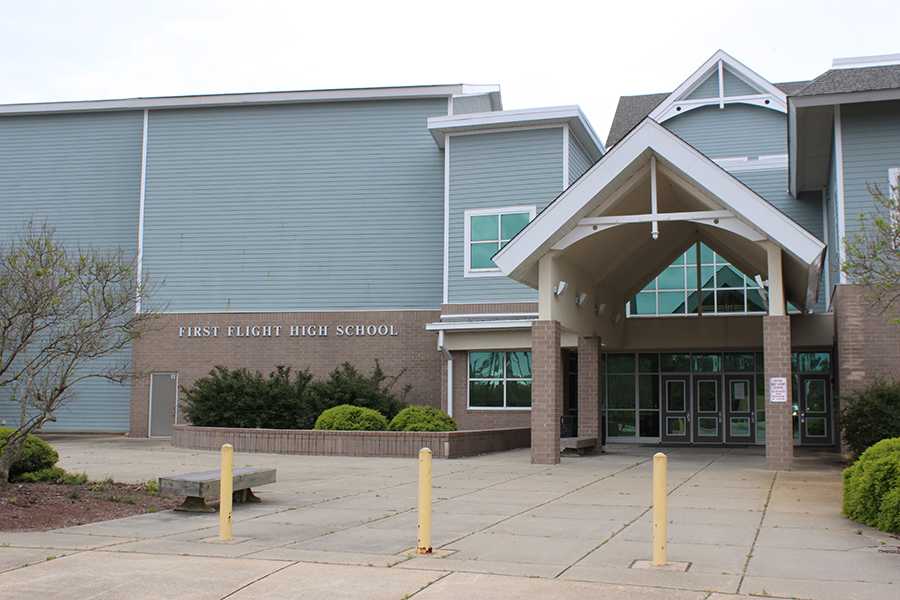
This is something that First Flight High School science teacher Katie Neller has experienced firsthand. Upon receiving many new students who didn’t speak English, Neller was determined to help each student despite the language barrier.
“I’m getting more and more Spanish-speaking students,” Neller said. “I see the challenges they have trying to understand English and I thought maybe if I could learn a little Spanish, I’d be able to help them a little.”
In addition to the Nags Head class, other Spanish classes are being offered throughout the elementary schools in Dare County. Neller attends the First Flight Elementary School Spanish class, which she says can be difficult at times.
“It’s really hard, and our Spanish teacher teaches it like my Spanish-speaking students,” Neller said. “They’re just thrown in a class with all English (materials) and kind of have to catch up.”
This has given Neller a good perspective on what her Spanish-speaking students are going through. Sometimes they have trouble keeping up with the rest of the class because they have to use online translators that slow them down.
Much like Neller, health sciences teacher Jennifer Kovacs wants to learn Spanish for her students, but she also wants to do so for her patients. Working as a nurse some weekends, Kovacs sees the necessity to be able to speak more than one language to better assist her patients.
Kovacs explained that taking a Spanish class has great value, especially for parents of Dual Language Immersion (DLI) students, teachers, nurses and many community members who hope to broaden their understanding of another language.
“I figured when I took the class, I might be able to speak to my patients a little bit better. I don’t know about that – I think I’m still gonna be using Google Translate,” Kovacs said with a chuckle. “But at least I’ve tried and I’ve stretched out of my comfort zone and I was able to carve time out for something that interests me just to kind of listen and see what I can learn.”
While these classes have expanded over time, Mora Newton, coordinator of Dare County Schools’ DLI program, explained that originally the Spanish classes were for the parents of students in the DLI program so that parents could help their children with their homework.
However, over time the program morphed into a whole community affair, where everyone was invited to participate, but classes hadn’t been able to start because of COVID. The most recent class started in January, with teachers, parents and community members enrolling.
“We do have a growing Latino Spanish-speaking population and, especially when we have students who are enrolling in high school new to the country or new to Dare County, it’s scary,” Newton said. “Even basic conversation, not talking about, ‘Can you understand the high school science or social studies or math curriculum,’ but can you ask your teacher for permission to go the bathroom?”
With many DCS teachers and employees being part of the program, Newton explained that the purpose of learning Spanish is not just to teach in another language but to be someone students can rely on.
Newton said she’s been speaking with teachers and Central Office staff about plans to help teachers know the basics about communicating with students who don’t speak English. At the same time, she praises the time and dedication adult students have put in to learn Spanish.
“When something is hard for us, we’re not naturally inclined to keep trying, and so when something like a language becomes harder and harder with age, it’s easier to just not try,” Newton said. “Having a large section of our community open to that and wanting to try it I think speaks towards the future and just how we can be more accepting of others and be willing to take a chance and grow and learn when it’s not the easiest thing to do.”
Senior Daisy Morales Bravo can be reached at 23moralesda04@daretolearn.org.