









By Kayla Hallac, Editor-in-Chief
Editor’s note: The three people quoted in this story as Sarah, Mary and Jane preferred to remain anonymous. They are FFHS students who have or are currently struggling with eating disorders.
“I was declared anorexic,” Sarah said.
“I stopped eating,” Mary added.
“I didn’t like when I looked at myself in the mirror,” Jane explained.
According to the National Institute of Mental Health, 0.6% of Americans are impacted by anorexia and 0.3% suffer from bulimia. The prevalence of eating disorders among U.S. adolescents from 13 to 18 years is 2.7%.
That may seem like a small number, but take a place like FFHS with about a thousand students and you’re suddenly talking about 27 people – enough to fill a classroom.
Anorexia nervosa is an eating disorder characterized by restriction of food intake leading to low body weight, typically accompanied by intense fear of gaining weight and disturbed perception of body weight and image. Bulimia nervosa involves eating large quantities of food and then reacting to binge episodes in unhealthy ways, including forced vomiting.
Recovering from an eating disorder such as anorexia is not a clearly designed path. It can be messy. Stressful. Uncomfortable. But the good news is that recovery IS possible.
BITING INTO A BAGEL AFTER FIVE MONTHS
It was the beginning of the COVID-19 quarantine. Everyone was home and social media activity skyrocketed. This was the first trigger for Sarah’s eating disorder.
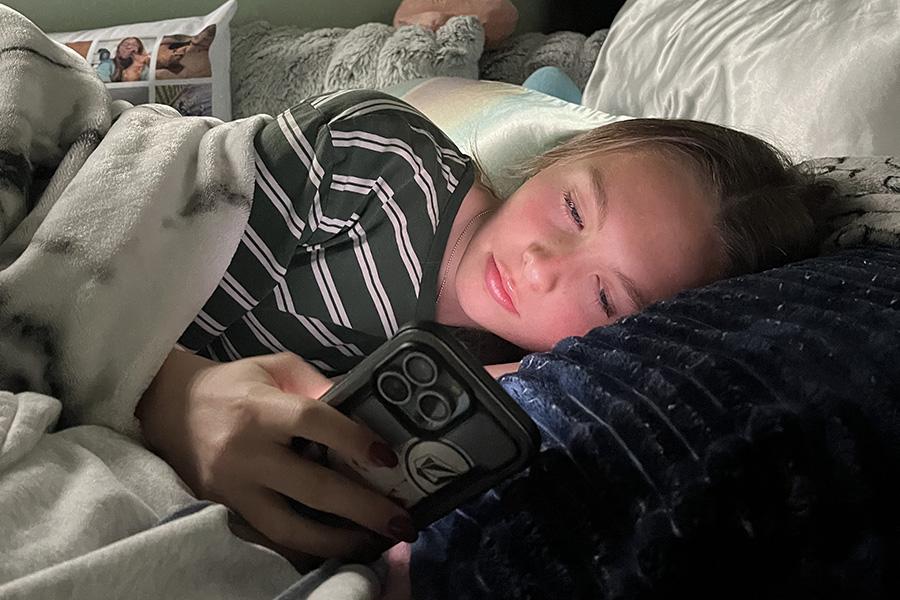
“A big starter for me was social activities and social media – just comparing myself to other girls my age,” Sarah said. “I was pretty much alone and I didn’t have many people to talk to and every time that I went on my phone, I’d see a bunch of workout videos.”
The social media influence at first motivated Sarah to improve her nutrition. She started increasing physical activity and researching adequate calories and nutrients she should consume each day. The healthy routine slowly spiraled out of control.
“You’d still see people out there who weigh less than you and it just goes back to the whole comparison,” Sarah said. “So I would push myself on those runs. I would maybe go an extra mile than I planned or I would just not have a snack in between lunch and dinner. It slowly became to where I would track the calories of every little thing that I ate.”
Sarah got to the point where she consumed the amount of calories a toddler should have each day. She continued this for months before she and others noticed an issue. The first signs Sarah experienced were getting cold in the middle of the summer, not having any motivation to go out or talk to anyone, feeling sluggish and bruising easily.
“I wasn’t getting the nutrients that would help my muscles and my bones repair themselves after working out,” Sarah said. “I became very frail and extremely thin to the point where my friends would tell me that I looked like a skeleton.”
One of the most challenging components of Sarah’s journey was the stigma around eating disorders.
“My boyfriend at the time said, ‘Just don’t tell too many people. It’ll just make it seem like you’re doing it for attention.’ If I would tell someone, it was my way of crying for help. I didn’t know what to do,” Sarah said.
Making the turn to recovery happened at a crucial point in Sarah’s journey. If she continued her habits for just a few more weeks, she would have had to enter intensive treatment unavailable in the local area.
“It was still very hard to not restrict. At that point, I already knew the calorie counts in a hamburger bun and how much would be in the hamburger and in the cheese and that’s all I could think about,” Sarah said. “It took me five months to eat a normal bagel without freaking out.”
With the motivation of family, friends and nutritional therapy, she healthily gained back her weight.
“It’s the push and the motivation from not leaving my friends and family behind and also the fact that I’ll be able to do everyday activities again without being exhausted,” Sarah said. “And it’s that I wouldn’t look sick anymore and I would look healthy and normal. All of that pushed me through the process.”
Throughout her recovery, Sarah has learned many lessons. She’s learned to stop comparing herself to others, and instead focus on body positivity. She’s learned how much it means to be validated by others in troubling times. Most of all, she’s learned to boycott diet culture.
“Completely get it set in your mind that the whole diet culture is just a whole facade and it’s just there to make money, not to make you feel better about yourself,” Sarah said.
THE DOWNFALL OF DEBBIE’S DONUTS
After contracting mononucleosis in the eighth grade, Mary lost a lot of weight.
“I started gaining it back when I got better. I didn’t like that. I wanted to be skinny again, so I stopped eating,” Mary said.
After that initial decision, little moments along Mary’s journey acted as fuel for her eating disorder.
“One day when I came home, I started eating a bunch of Little Debbie stuff. My brother came over and he got so mad at me because they were all gone,” Mary said. “I haven’t eaten one since because he called me fat.”
This instance proved to Mary that food had become a central point of her life.
“I think about food a lot,” Mary said. “I’m always looking at the calories on everything and I always think ‘that’s like way too many’ or ‘the carbs in it are too much.’ Just looking at pasta, I don’t even know.”
Foods like pasta and fast food have become fear foods for Mary, but with the help of her therapist and best friend she’s made a lot of progress.
“She’s always there for me when I need to talk. She told me to get help,” Mary said. “Now I talk to someone every week about what scared me that week or what I ate that was big.”
Despite the challenges Mary has faced, she recognizes her progress and the nature of eating disorders.
“They’re definitely a weird thing in general; you never think it’s gonna happen to you. It does, and you don’t realize how common they are,” Mary said.
PRESSURE WHILE PUBLICLY EATING
Jane was in seventh grade, a time “when people start caring more about what they look like and what other people see them as,” she said. Creating a thinner image of herself was caused by triggers both on social media and in social situations.
“It was mainly lunches, definitely eating in public I struggled with for some reason,” Jane said. “I didn’t eat lunch at school for a long time. This year and last year was the first I had in a while.”
The middle school setting made it difficult for Jane to overcome her eating disorder. She didn’t know how to feel about her 12- and 13-year-old friends noticing something was wrong.
“I was scared and uncomfortable,” Jane said. “I wanted to be normal. People don’t think that’s normal. I wasn’t sure if it was bad that people knew because I didn’t know how it was going to affect my life. I was nervous that they would over-exaggerate it and tell my parents, and I was like, ‘No, guys, I’m fine.’ ”
Jane was not fine. The physical and mental struggle of feeling guilty after eating carried on for about three years.
“Even if I was losing weight, I didn’t like when I looked at myself in the mirror. I wasn’t seeing anything different. I didn’t think that what I saw in the mirror was different from how other people saw me,” Jane said. “I definitely did lose weight, but I did not see it. I’d be like, ‘Oh no, the scale’s broken.’ ”
Around the end of last year, Jane made a turn to use social media to motivate her instead of letting it bring her down.
“I’d follow people on social media who’d dealt with similar things or put up positive energy on their platforms and it would motivate me to do better,” Jane said. “I did feel alone a lot during this time. I wish I knew what could’ve been done to help earlier.”
You are not alone. If you or a loved one may have an eating disorder, visit https://www.nationaleatingdisorders.org/help-support/contact-helpline for additional resources.
Senior Kayla Hallac can be reached at 22hallacka85@daretolearn.org.