














By Mary Pat Thompson, Editor-in-Chief
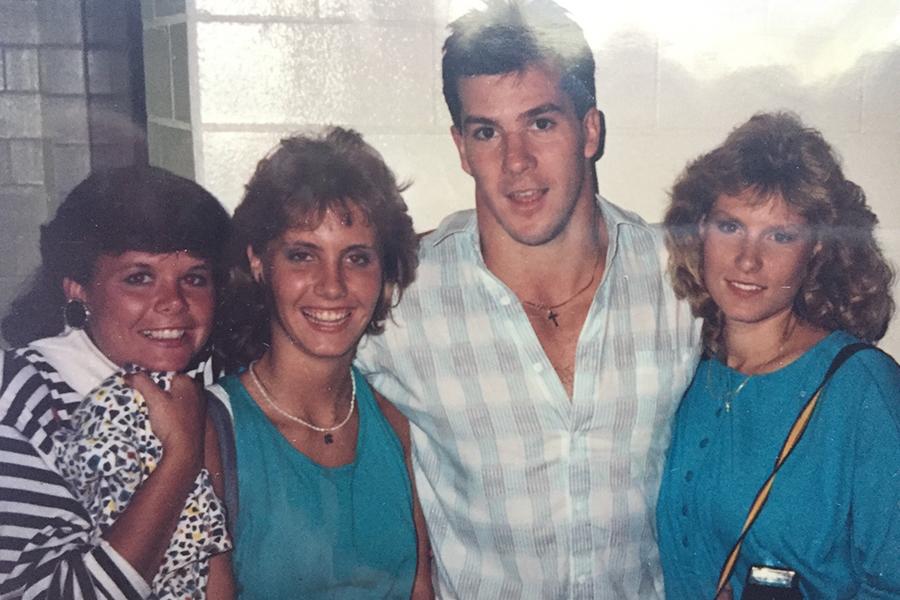
The year is 1985 and senior Amy Edwards is spending her last period of the day in D.H. Conley High School’s newspaper room. She’s the editor-in-chief of the school’s student-run paper, The Shield. Leaning over an elongated desk with an X-ACTO Knife in hand, Edwards pushes her hair — her big hair, it is the ‘80s after all — out of her face before perfecting the most current issue’s layout. Edwards is passionate about journalism and has plans to pursue it in college. Right now, though, she’s really into sports. Because she lives in Greenville, her family attends all the East Carolina games regularly, both home and away. She’s always played a lot of volleyball, and sort of regrets not trying out for the school team. Edwards did make the basketball team, albeit as a benchwarmer. But that doesn’t matter. She loves the game. Soon she’ll be studying at UNC Chapel Hill, her dream school — no matter what her Tar Heel-hating dad says. Maybe she’ll be able to combine both of her passions — sports and journalism — in Chapel Hill. We’ll see. But for now, it’s back to fitting stories attractively on the front page.

Edwards, known to the Outer Banks community as English teacher Amy Powell, went off to college and became involved in the publications at Chapel Hill.
“I joined the yearbook staff and quickly became the sports editor after just a few months. With that yearbook, we did a lot of feature stories. So, I wrote most of them,” Powell said. “Then it just continued from there. I didn’t work for The Daily Tar Heel, but I worked for the Summer Tar Heel, which is a weekly version of The Daily Tar Heel.”
Powell’s work on these publications led to her applying for an internship in the Sports Information Department. It was a competitive position — she applied twice — and finally got the job during her senior year at Carolina. It consisted of writing stories about the different athletes and games as well as handling strategic communication for the athletic department.
“We were required to work at least a minimum of 10 hours in the office each week, but I would at least double that,” Powell said. “It was just something I loved to do. Some people like to write about politics. I like to write about sports.”
But although she loved her job, she was a bit aggravated by her story assignments.
“Everybody covered football equally,” Powell said. “I did the play-by-play and press booth. I had the microphone and I would call the plays on the field so the reporters could write down, ‘First down!’ ‘One to go!’ ”
The same can be said for basketball. But other than that, Powell noticed that the men in her department got to cover the popular sports, while she got stuck with, well, whatever was left.
“I thought that was odd: The idea that a female wouldn’t be able to get as good information because you wouldn’t be able to be in the locker room after the games or before the games to talk to the players,” Powell said.
But that wouldn’t have hindered Powell’s ability to get in touch with the athletes. She had connections. In fact, she was dating a Carolina baseball player at the time, and was friends with lots of players on various UNC sports teams.
“The thing is — I knew all the players. I knew stuff about them that other people didn’t. I knew interesting stories about them. And I could have had such great stories to tell and to promote them and the team,” Powell said. “One of the assistant sports information directors wanted (to cover baseball), and he picked two other interns to work with him, and both of them were male. And I’m thinking, ‘You’re not gonna know some of the stories I do, because these are things that have come up in conversation at dinner, and hanging out together, not in an interview.’ ”
The Sports Information Department itself was already small, with just under 15 employees. Within the group there were only three females — Powell, another intern, and a secretary. For a while she thought that just because she was a girl, she would have to cover the women’s sports. But that theory also proved false.
“Women’s soccer had won I don’t know how many national championships in a row — 10, 12 or so. But no women covered that one either because it was considered a good sport to cover,” Powell said.
She really tried not to let it bother her. Because she didn’t have to work the baseball games, Powell could wear her Carolina blue and cheer for her boyfriend as loud as she wanted. She could meet up with her friends and go support the women’s soccer team. She could still be a sports fan. But it did sting to know that she could be writing really great pieces if only given the chance.
Not only did the department write news stories about the athletes, but they served as a sort of public relations for the athletic teams, arranging events in order to bring positive publicity. A few times a semester, the group arranged for the Carolina football team to head over to the local hospital to visit sick children.
“Someone from the hospital would call and say, ‘Hey, we have an overflow of kids, it would be really nice if we could get some athletes over here to hang out with them and color,’ ” Powell said. “We would go to the children’s wing, and then I would take pictures, and then I’d write a story about it. We’d send it out to the press and it would make everybody look good.”
Although Powell wasn’t the only one who planned these events by any means, it seemed like she always got chosen to accompany the boys during the walk from the Dean Dome to the hospital as a “glorified babysitter,” she jokes. “They thought it also looked cuter to have a girl with them instead of a guy escorting them. It was all about looks, I think. It was always like, ‘OK, Amy, head on over! Make sure you get the angle of the really big football player with the tiny little kid and they’re drawing together.’’
Sometimes, after Powell would cover basketball games, she’d head over to Franklin Street. It’s home to a popular sports restaurant called Four Corners — named after Dean Smith’s famous offensive strategy — where fans and athletes crowd after the final buzzer. It’s also where Powell worked part time, enjoyed many a mozzarella stick and continually carved her initials into the wall. The last thing she wanted while hanging out at Four Corners was to be hit on.
“Especially when it’s someone your dad’s age. That’s really gross. I remember one time going there and a much older, like, gross older sports announcer who’s very famous was in there,” Powell said. “And, well, there were a lot of people there who were not sober. It was very crowded, and you could tell he was groping people. It just made me sick. Because earlier, oh! — and he was very drunk — earlier he was also very flirty. It was just gross.”
Younger up-and-coming sports journalists would also try to get away with things. In particular, one man who worked for CBS Sports (who Powell said just happened to have an alcohol problem that impeded his job and got him fired) always made sexual advances toward women, including Powell.
“It was always the idea of, ‘I’m famous, I’m on TV, I’m important, don’t you want to be with me?’ kind-of-thing. Like, uhhh — no, no and no! It made me sick to my stomach, but at the same time we were laughing at them because they were pitiful,” Powell said. “I mean, what do they think it is, Hollywood? That someone is gonna try to be with someone to get to another level or something? I had a boyfriend. Why would I be interested in someone else?”
In the moment, it didn’t seem like all of these occurrences — the less-than-ideal story assignments, the “glorified babysitting,” the unwarranted advances — had anything to do with sexism. But, with years of reflection, Powell sees it as just that.
“Now that I look back on it, I recognize it more. When it was happening, a lot of the times I laughed it off as a joke. I thought, ‘These people are pitiful.’ That’s a pitiful way to try to get a date. Or, a pitiful way to use your position to try to impress someone. The whole deal with the guys taking the best sports, I felt that was a losing battle. I made good of it by saying, ‘Well, I can be a fan instead.’ But when I look at it now, I think, ‘GOL-LY, why didn’t I speak up more?” Powell expressed.
“If it was happening today it would definitely have been different. It certainly would be,” Powell continued. “The person that I am today, I would definitely speak up to my boss. I certainly would say something to put the drunk broadcasters in their place. A little more so than, ‘Not interested, I have a boyfriend,’ laughing at them and then walking away. That probably didn’t do the trick.”
Even so, Powell doesn’t have any regrets. It was her dream, after all, to combine her love of both sports and journalism. It led her to other opportunities, which ultimately brought her to the Outer Banks. Although she’s teaching First Flight students everything from the basics of sentence structure to the art of satire, she’s still invested in sports. Her son, Trent, was part of the 2016 NCHSAA state championship soccer team and has plans to continue with soccer in college after he graduates in a couple years. Her Tar Heels won the NCAA basketball championship in April. Sports are still a part of her life, just as much now as they were during her college internship.
“I didn’t like some aspects of it. But it was a good experience for me because it let me know that it was not a career that I would ultimately pursue,” Powell said. “That’s one thing an internship does, it makes you decide if this is what I want to do with my life. Sports are still an important part of my life, but not in the same way.”
Senior Mary Pat Thompson can be reached at thompsonma1001@daretolearn.org.
Editor’s note: Thompson’s senior project at FFHS dealt with aspects of censorship in the media. This story was the product of her senior project.

Tom Edwards • Jun 8, 2017 at 7:57 am
I was teaching at MHS when she came to the OBX. She is one of my favorites and we have stayed in touch over the years. I retired in 2001 and still remember the great times we had together. Thanks for an awesome well written article‼️