







By Hunter Haskett, Editor-in-Chief
Senior Jacy Copeland is craving something savory. A Big Mac to be specific.
The blender whirls as she eagerly awaits the greasy goodness. Her mom adds a little milk – to make it blend more smoothly, of course. Voila! Copeland’s long-awaited slush of beef, pickles, special sauce and a bun is ready.Just how everyone wants to consume their McDonald’s favorite, right?
“It was a bad day, and when I have days like that I normally go out and treat myself to a Big Mac,” Copeland said. “I begged my mom and she brought home a Big Mac and we pureed it and I drank it.”
Here’s hoping, however, that Copeland’s bad days due to Temporomandibular Joint Disorder are behind her. TMJ causes problems with the joint that connects the jaw to the temporal bones of the face. With TMJ, eating some foods made her jaw hurt, and the disorder eventually would have caused breathing problems later in life.
“The top and bottom jaw, they didn’t line up and one was bigger than the other, so it was pretty much like the top jaw belonged to a different person than the bottom jaw did,” Copeland said.
Copeland, her family and her doctors decided that undergoing mandibular osteotomy – lower jaw surgery – was the best option to relieve her of the painful jaw issues. The surgery took place Oct. 11.
“They broke my bottom jaw in two places and put a plate and screws in there,” Copeland said. “They also broke my top jaw, like the front-center area, and put a plate and screws in.”
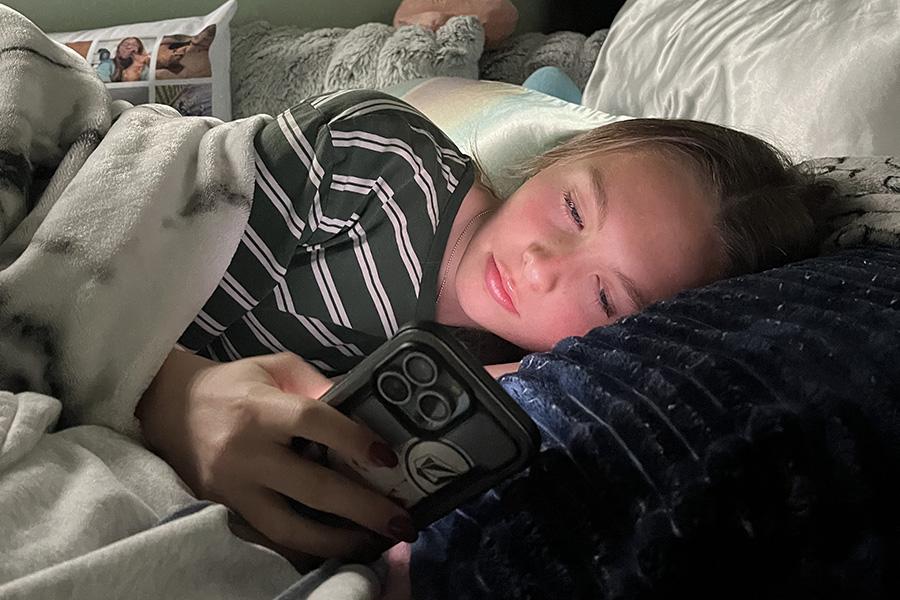
After surgery, Copeland was left with an extremely swollen face and a wider nose than she originally had. With so much swelling, she was dizzy for the first week and spent most of it resting in bed.
“The first week is just painful and miserable, and you don’t really do anything, you just try and keep living,” Copeland said.
Such an extensive operation led Copeland to a six-week recovery time that involved a completely liquid diet because of a mouth that was shut tight with rubber bands.
Which meant no talking – no easy feat for her extroverted personality.
“I did not do good at that. I got a little dry-erase board and I would write what I was thinking. That was definitely a switch because I normally just say what I am thinking, so it took a lot longer to write it,” Copeland said.
After the first week, Copeland had her bands removed slowly, a week at a time, until the sixth and final week, when almost all the bands were taken out. Until then, she perfected the art of talking through closed teeth.
“I started talking with my mouth closed like a ventriloquist, so that wasn’t too bad,” Copeland said. “My mom’s always saying now that she wants a refund because they told her six weeks of quiet and she didn’t get it – she got like a week and a half.”
Copeland may have found a way to bypass the no-talking element of her recovery, but wasn’t so lucky with eating.
“Your mouth is so swollen and you can’t open your mouth so the only way to do it (eat) is through liquids,” Copeland said. “So you take a syringe and put the tip of the syringe between your cheek and your teeth and you just squeeze it (food) out.”
In addition to the physical challenges of her recovery, Copeland struggled with the isolation that came with it.
“I prepared myself for it, so it was about what I expected,” Copeland explained. “But getting over not being able to talk, not being able to eat, and not getting to go to school and just a lot of the stuff I missed out on, that was the hard part. I missed all of my friends.”
Weekly visits from fellow senior Cecilia Cortez helped keep Copeland feeling involved in the FFHS community during her recovery. They either caught up on online classwork or just chatted about everything that had happened since they’d last seen each other.
“We would always go on walks because she doesn’t like to stay inside for that long,” Cortez said. “I’d be telling her something and she’d already know the story – it’s like she never even left school. It was funny because I was more in the know for Jacy’s sake than my own.”
Copeland’s calculus teacher, Sam DeWitt, also came to her house twice a week and gave a condensed version of the daily lessons to keep her on track with the rest of the class.
“We only do some of the examples and then I explain what we did. We can usually cover two, three days within one sitting,” DeWitt said.
Having the help of DeWitt and her other homebound teacher, Chris Mascio, made it easier for Copeland to stay caught up with her work, but she still missed the structure of a regular school day.
“I just had to have the motivation to do it. It’s so easy to get distracted because I’m not in a school environment,” Copeland said.
Copeland returned to school on Nov. 26, almost six weeks after she left. Her swelling decreased tremendously and she was excited to be back after a long break – unlike most people on the Monday morning after Thanksgiving.
“Yeah, I was definitely excited to see everybody and everyone has been so welcoming. It’s nice to be back,” Copeland said. “Charlotte Tyson got me a ‘women in science’ 500-piece puzzle and I’m very excited.”
The feeling is mutual. Copeland’s teachers and friends have dearly missed her enthusiastic personality and bright smile.
“I’m really happy she’s back,” Cortez said. “She’s in my lunch group and it was incomplete without her.”
And after her long first day back at school was done, Copeland walked into McDonald’s and ordered herself a Big Mac. She went to the table, the warm, juicy burger sitting in front of her, and took a big bite. It took her awhile to finish, but she chewed the whole thing.
It was a good day.
Senior Hunter Haskett can be reached at hasketthu0318@daretolearn.org.